
Lead With Manners.
Live With Meaning.
Home / Personal Relationships Etiquette
Lead With Manners.

Live With Meaning.

Work / Business Etiquette
Social / Group Etiquette


Home / Personal Relationships Etiquette
-
Say “please,” “thank you,” and “excuse me” regularly — even with loved ones.
Ask before borrowing or using someone else’s belongings.
Be mindful of noise levels, especially early in the morning or late at night.
Knock before entering closed rooms.
Clean up after yourself in shared living spaces.
-
Listen with empathy and attention; don’t minimize others’ feelings.
Apologize sincerely when you’re wrong.
Avoid yelling or speaking in a demeaning tone.
Express appreciation for help, support, or affection.
Respect personal space and time — everyone needs boundaries.
-
Contribute to chores and responsibilities fairly.
Communicate openly about expectations and concerns.
Be honest, but kind — don’t weaponize the truth.
Celebrate others’ wins and milestones (big or small).
Be present — put the phone down during meals and conversations.
Social / Group Etiquette

-
Acknowledge everyone when joining a group or event.
Don’t dominate conversations — invite others to speak.
Introduce people to each other when appropriate.
Avoid interrupting, correcting, or “one-upping” others in casual talk.
Wait your turn in line or conversation.
-
Be mindful of cultural differences and inclusive language.
Don’t make jokes at someone else’s expense.
Make sure everyone feels welcome, especially newcomers.
Avoid controversial or overly personal topics unless you know the group well.
-
RSVP promptly to invitations.
Arrive on time, or let someone know if you’re running late.
Bring a small gift or gesture when invited to someone’s home (wine, flowers, etc.).
Offer to help or clean up when the gathering ends.
Follow up with a thank-you message to the host.
-
Don’t post photos of others without their permission.
Refrain from texting or scrolling when in conversation.
Avoid oversharing or venting on social media in ways that affect others
Work / Business Etiquette
-
Greet colleagues and clients with a smile and eye contact.
Address people by name and appropriate title (unless told otherwise).
Arrive on time for meetings and appointments.
Dress appropriately for your role and environment.
Speak clearly and avoid slang or overly casual language in formal settings.
-
Listen without interrupting; allow others to finish their thoughts.
Respond to emails and messages in a timely manner.
Keep your phone on silent or vibrate during meetings.
Avoid gossip or speaking poorly about coworkers.
Give credit where it’s due — acknowledge teamwork and effort.
-
Respect shared spaces (e.g., clean up after yourself in the kitchen or meeting rooms).
Don’t hover over someone’s desk without asking.
Knock before entering an office or cubicle.
Respect boundaries — avoid prying into coworkers' personal lives.
Don’t take credit for someone else’s work or ideas.
-
Mute your mic on video calls when not speaking.
Be punctual and prepared for virtual meetings.
Avoid typing or multitasking when others are presenting.
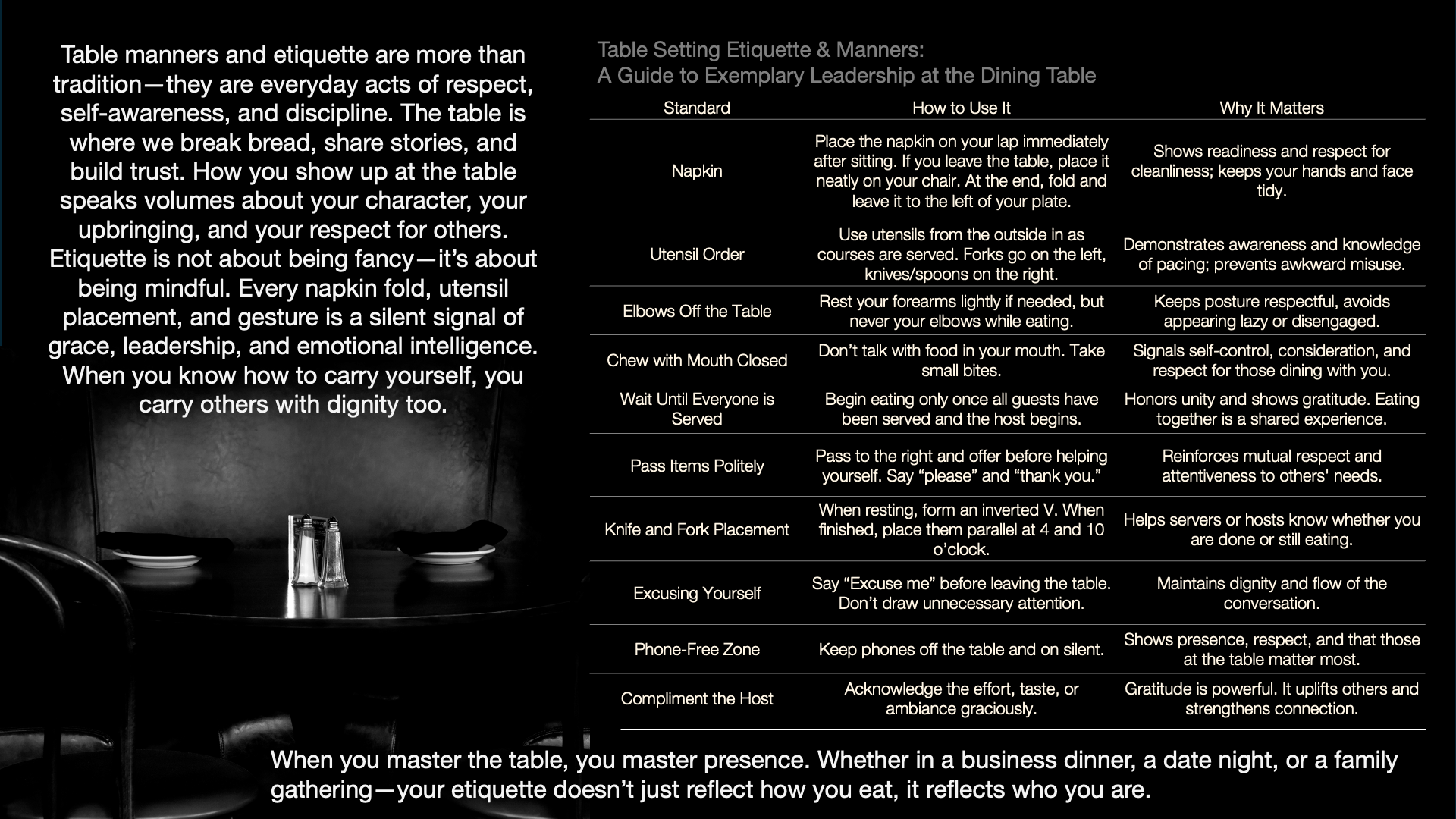
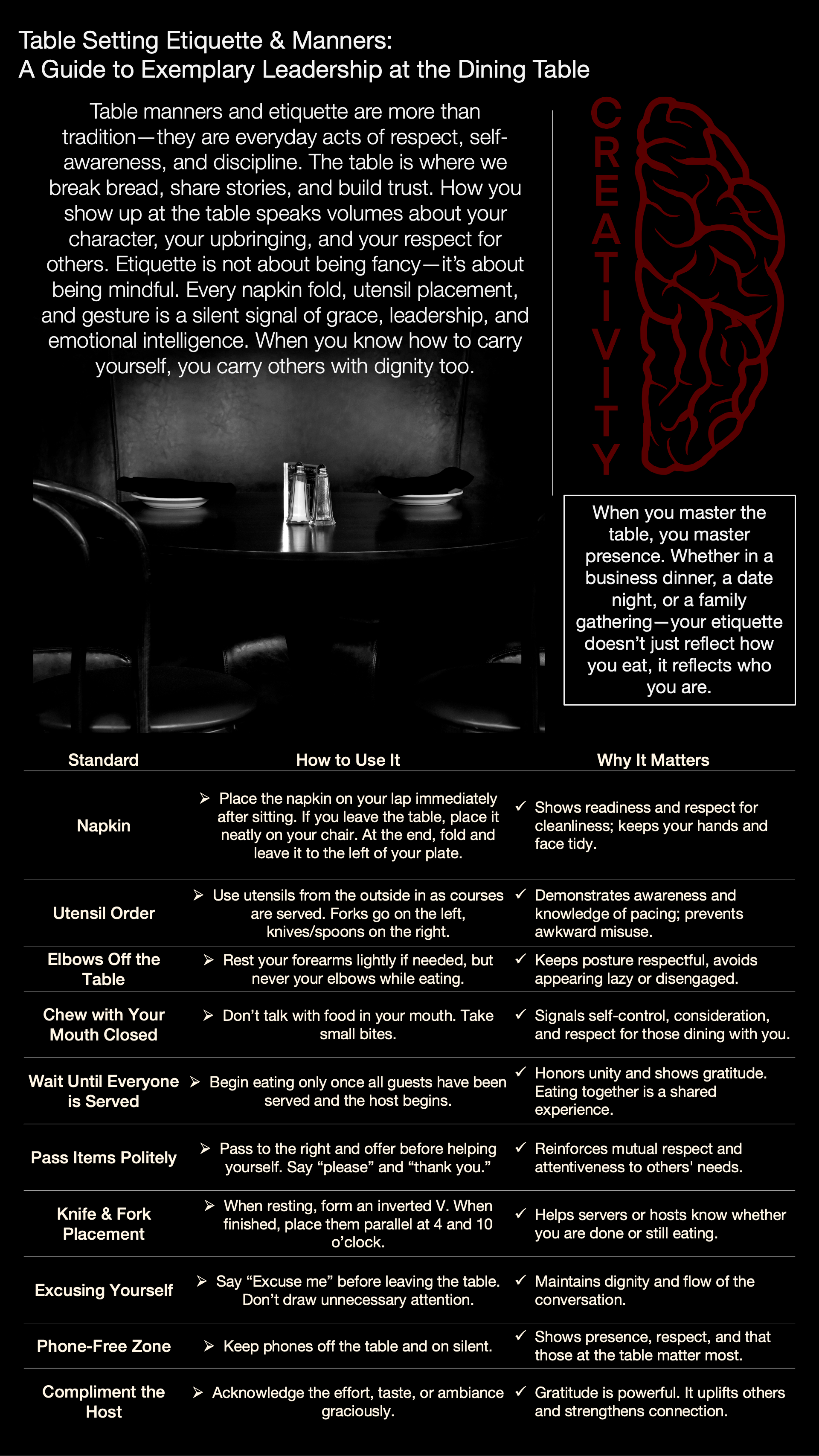
The way you dine reflects the way you lead.

Masculine Role Etiquette
Leadership, Protection, Purpose
These expressions focus on stability, initiative, responsibility, and decisive action.
-
Stand tall with grounded posture — calm, assertive, and alert.
Speak clearly, confidently, and with intention.
Offer a firm (but not aggressive) handshake; make steady eye contact.
Be mindful of personal space — don’t intimidate or crowd.
-
Hold doors, offer your seat, or assist with heavy items — not from superiority, but from courtesy and protection.
Be punctual and dependable — masculine energy keeps its word.
Lead with calmness in tense situations; offer solutions, not drama.
Take initiative — whether paying for a date, planning, or checking in.
Last to order/get their food.
-
Dress appropriately and with care — groomed, clean, and intentional.
Avoid dominating conversations — let others speak and listen fully.
Practice restraint — know when to hold back opinions or emotions
-
Defend the dignity of others when needed (stand up to rudeness or injustice).
Speak directly, not passive-aggressively.
Keep confidentiality and loyalty — trust is a masculine foundation.
Avoid crude humor or objectifying others, especially in public company
Feminine Role Etiquette
Grace, Nurture, Receptivity
These expressions often revolve around attentiveness, empathy, elegance, and social harmony.
-
Carry yourself with poise: soft body language, calm tone, and fluid gestures.
Speak with warmth and intention; avoid harshness in tone or criticism.
Maintain good posture and refined movements, especially in social settings.
Make eye contact with kindness, not confrontation.
-
Be gracious and welcoming to newcomers or guests.
Express appreciation often — “thank you” and compliments are powerful.
Use tact and diplomacy when offering feedback or voicing concerns.
Offer help and care without being overbearing (emotional intelligence).
Know when to receive — compliments, help, or support — with gratitude, not guilt.
-
Dress with thoughtfulness to the occasion and your body’s expression.
Practice cleanliness and attention to detail (hands, nails, scent, etc.
Sit and move with grace (e.g., crossed ankles, smooth transitions when sitting or standing).
-
Say “no” with elegance and firmness — not from guilt, but self-worth.
Avoid gossip and petty comparisons; uplift others in absence and presence.
Communicate emotions clearly but not manipulatively.